
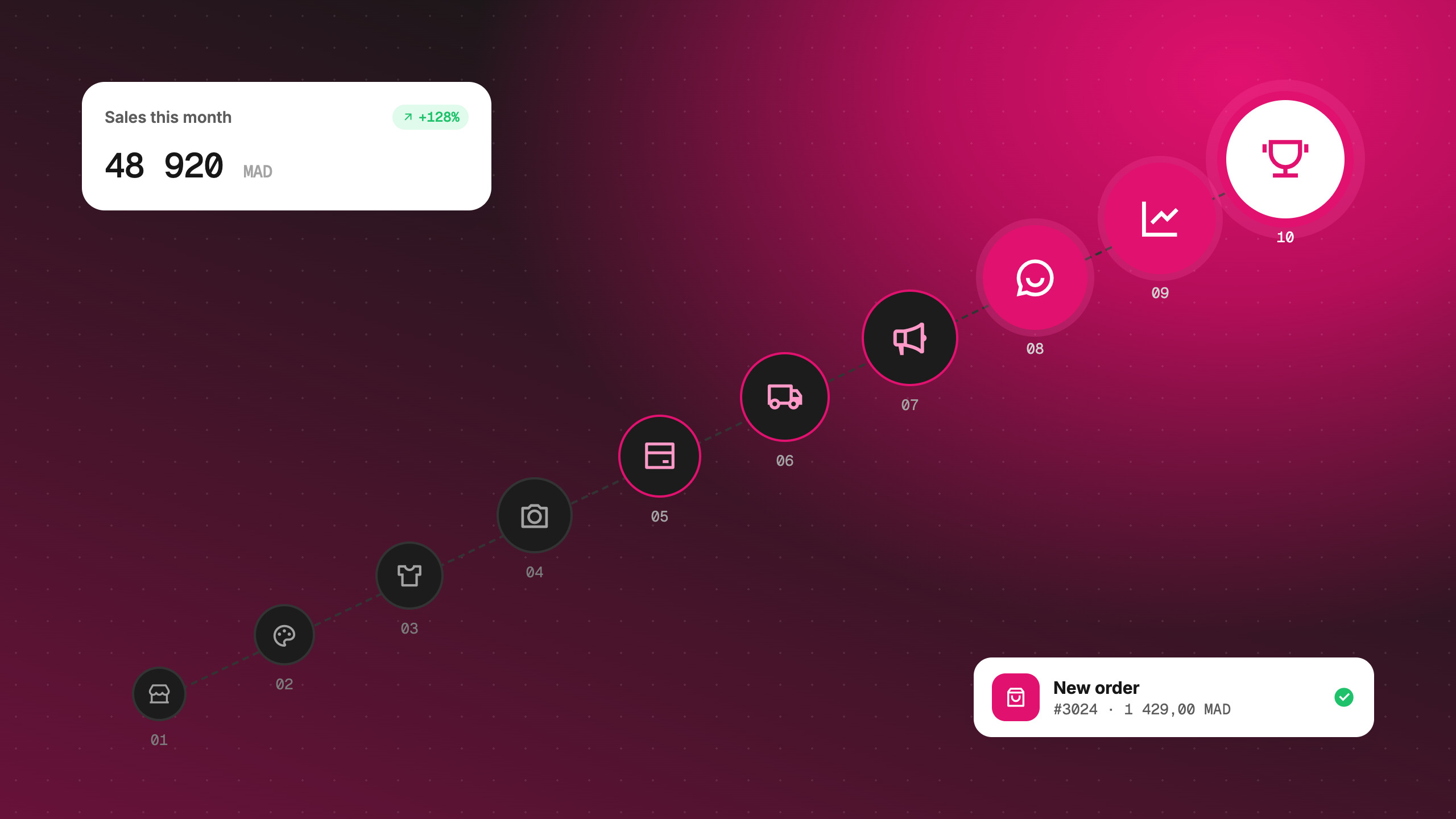
Creating an online store and adding products to it doesn’t guarantee that sales will follow automatically. Once your store is launched, a more important stage begins: How do you attract the right customers? How do you turn visits into orders? And how do you encourage customers to buy again?
In e-commerce, success doesn’t depend on a single factor. It comes from several elements working together, from choosing the right product and creating a strong user experience to optimizing product pages and payment options, running ads, improving SEO, and analyzing data.
In this guide, we will explore 10 practical steps to improve your online store and increase your sales, whether you are just starting your online selling journey or already have an established store and want to improve its performance.
1. Choose a Product with Real Sales Potential
Before thinking about ads or store design, ask yourself: Is there real demand for this product?
Choosing the right product is one of the most important decisions affecting the success of an e-commerce store. This doesn’t necessarily mean looking for a magic product that generates huge sales, but rather finding a product that meets a clear need or solves a problem for a specific group of customers.
When looking for a winning product, consider several factors:
- Are people searching for this product?
- Does it solve a problem or provide a clear benefit?
- How competitive is the market?
- Does its price allow for a suitable profit margin?
- Is it easy to ship?
- Can it be offered as part of bundles or special offers?
- Can complementary products be sold with it?
You can also study the products that are currently in demand and monitor search and content trends on platforms such as Google, TikTok, and Instagram instead of relying on assumptions alone.
2. Create a Product Page That Encourages Customers to Buy
Your ad may successfully bring thousands of visitors to your store, but if your product page is unclear or fails to build trust, those visits may not turn into sales.
A good product page should quickly answer the questions in the customer's mind:
What is the product? What will it do for me? How much does it cost? Why should I buy it from you? And how will I receive it?
To improve your product page, make sure it includes:
- Clear, high-quality images
- Images from different angles
- A product video when useful
- A clear and direct title
- A description focused on benefits, not only specifications
- Clearly displayed prices and offers
- Shipping and delivery information
- Available payment options
- Customer reviews and ratings when available
- A clear and easy-to-find purchase button
You don’t necessarily need advanced design or coding skills to create a professional product page. With \\\[YouCan\\\](https://youcan.shop/ar-ma), you can create your online store and product pages and customize their appearance without building everything from scratch.
You can also use the AI-powered tools available within the platform, including the AI image generator, to help create suitable product images and marketing content more quickly.
How Do You Know If Your Product Page Needs Improvement?
If your store receives a good number of visitors but only a small percentage of them add products to their cart or make a purchase, the problem may be related to the product page, the offer, or the overall user experience.
This is where an important e-commerce concept comes in: \[Conversion Rate\](https://youcan.shop/en/blog/posts/conversion-rate)
3. Use the Right Landing Page for Your Ad Campaigns
When you launch an ad on Meta or TikTok, having a good ad isn’t enough. The page customers reach after clicking the ad should be consistent with the message and offer in the ad.
This page is commonly called a Landing Page.
For example, if your ad promotes a specific product with a special offer, it is better to send customers directly to a page that presents the same product and offer rather than sending them to your homepage and making them search for the product themselves.
Try to keep the customer journey simple:
Ad → Landing Page → Product → Checkout → Order Confirmation
To strengthen your Landing Page:
- Make the offer clear from the beginning
- Use an attention-grabbing headline
- Clearly explain the main product benefit
- Use relevant images
- Add Social Proof such as reviews or customer feedback
- Use a clear CTA such as “Order Now” or “Buy Now”
- Avoid unnecessary elements that may distract visitors
The closer the page matches the ad, the easier it is for customers to understand the offer and make a purchase decision.
You can also take advantage of the new tools available in YouCan's Page Builder to create more effective landing pages.
4. Optimize Checkout and Make Purchasing Easier
You may successfully guide a customer all the way to the payment stage and still lose them at the final step. This is why Checkout Optimization is an important part of improving an online store.
The more complicated the checkout process is, the more likely customers are to abandon it.
Make the purchasing process:
- Simple and clear
- As fast as possible
- Mobile-friendly
- Clear about the final price
- Clear about shipping costs and delivery times
- Equipped with payment options that suit your customers
5. Use Upselling and Cross-selling to Increase Order Value
Increasing sales doesn’t always mean acquiring more customers. In many cases, you can increase the value of each order by offering relevant additional products or offers.
What is Upselling?
Upselling is encouraging a customer to purchase a better or more expensive version of the product they originally intended to buy in exchange for additional benefits.
What is Cross-selling?
Cross-selling means recommending a complementary product related to the item the customer has chosen. For example, if a customer buys a phone, you can recommend a suitable case or charger.
The key is to make sure these recommendations are genuinely relevant to the customer's needs rather than simply adding random products.
This can help increase Average Order Value (AOV) and generate more revenue from the same number of customers.
These options are also available through the YouCan dashboard.
6. If You Rely on COD, Take Order Confirmation Seriously
In many markets, especially across the Arab region, Cash on Delivery (COD) is an important part of the e-commerce experience. However, the sale doesn’t end when the customer submits an order.
It is important to confirm:
- The customer's willingness to receive the order
- The delivery address
- Product details and quantity
- Any information required for delivery
Order confirmation can help reduce unserious orders and problems that may occur during delivery.
Solutions such as \\\[YouCan Confirm\\\](https://confirm.youcan.shop/ar) can help merchants simplify and manage order confirmation, especially when they receive a large number of orders every day.
The key idea is that improving the post-purchase process is just as important as attracting the customer in the first place.
7. Reduce Returns and Improve the Shipping Experience
In e-commerce, a sale is not completely successful until the product reaches the customer.
Returns and undelivered orders can directly affect store profitability, especially when using the Cash on Delivery model.
To reduce these problems:
- Provide an accurate product description from the beginning
- Use clear and realistic product images
- Clearly explain sizes, colors, and specifications
- Verify customer information before shipping
- Use suitable packaging
- Choose a shipping company that fits your target market
- Keep customers informed about their shipment status
Solutions such as \\\[YouCan Ship\\\](https://ship.youcan.shop/en) and \\\[YouCan Fulfill\\\](https://youcan.shop/en/blog/posts/fulfill) help merchants organize different stages of shipping and logistics, allowing them to focus more on growing their stores.
Remember that the customer experience doesn’t end when they click “Buy.” It continues until they receive the product and beyond.
8. Test More Than One Advertising Strategy
If you rely on paid advertising to acquire customers, don’t build your campaign around a single ad or Creative.
You can test platforms such as:
- Meta Ads
- TikTok Ads
But the most important factor is testing what works for your audience and product.
Try different:
- Hooks
- Videos
- Images
- Marketing angles
- Offers
- Audiences
- Ad messages
Then monitor the results to understand what attracts the right customers and what doesn’t deliver the desired results.
Don’t use clicks as your only performance metric. An ad that generates a large number of visits isn’t necessarily the ad that generates the most sales.
Monitor the relationship between:
Ad → Click → Landing Page → Add to Cart → Checkout → Purchase
This journey helps you identify where improvements are needed.
9. Don't Ignore Retargeting
Not every visitor will buy on their first visit. A customer may view a product, read the details, and leave because the timing isn’t right, they want to compare prices, or they simply need more time to decide.
This is where retargeting comes in.
Retargeting campaigns can help you reach people who have already interacted with your store or content, such as:
- People who visited a product page
- People who added a product to their cart
- People who started checkout but didn’t complete it
- People who watched content or interacted with an ad
Instead of trying to attract a new person every time, retargeting allows you to reconnect with people who have already shown interest in your products.
However, give them a reason to come back, such as a relevant offer, a complementary product, useful content, or a reminder, instead of repeatedly showing the same ad.
10. Use SEO and Google Analytics to Make Better Decisions
Ads can bring traffic quickly, but SEO can help build a long-term presence for your store and content in search engines.
Start by understanding what your audience is searching for. You can create content and pages targeting keywords related to your products and industry while optimizing:
- Page titles
- Product descriptions
- Main and subheadings
- Images and alt text
- Internal links
- Store speed and user experience
But attracting traffic alone is not the goal. You also need to understand what happens after visitors arrive at your store. This is where Google Analytics and other analytics tools become important.
Monitor metrics such as:
- Number of visits
- Traffic sources
- Most viewed pages
- Products receiving the most interest
- Add-to-cart actions
- Checkout starts
- Purchases
- Conversion Rate
- Pages where visitors leave
This data helps you move from asking:
“Why am I not selling?”
to a more useful question:
“At which stage am I losing customers, and what can I improve?”
How Do You Know What Needs to Be Improved in Your Store?
If you want to increase your e-commerce sales, don’t always start by increasing your advertising budget.
Start by identifying where the problem is in the customer journey.
You have low traffic?
Focus on: SEO + Meta Ads + TikTok Ads + Content
You have a lot of traffic but few add-to-cart actions?
Review: Product + Price + Product Page + Offer + Trust
You have many add-to-cart actions but few sales?
Review: Checkout + Payment Options + Shipping + Final Price
You have many orders but a low delivery rate?
Focus on: Order Confirmation + Customer Data + Shipping + Post-purchase Experience
You have sales but a low Average Order Value?
Try: Upselling + Cross-selling + Bundles + Quantity Offers
This approach turns store optimization into an ongoing, data-driven process rather than a guessing game.
How Can You Increase Your E-commerce Sales in the Long Term?
No single method guarantees success for every online store. Products, audiences, markets, and competition differ from one business to another.
However, you can build an integrated growth system that combines:
The right product → A strong product page +/ An optimized landing page → A simple Checkout
→ Meta Ads and TikTok Ads → Retargeting → Order confirmation → Upselling and Cross-selling
→ Good shipping and customer experience → SEO and data analysis
Each stage affects the next one. Increasing traffic will not solve a weak product page. Improving the product page will not solve a complicated Checkout process. And increasing your advertising budget will not solve a problem where a large percentage of orders are not successfully delivered.
Start with the basics, then use data to identify what needs improvement. Over time, you can build a more efficient store, turn more visitors into customers, increase order value, and create an experience that encourages customers to come back.
E-commerce is an ongoing process of improvement, and every small improvement in the customer journey can make a meaningful difference to your store's results.